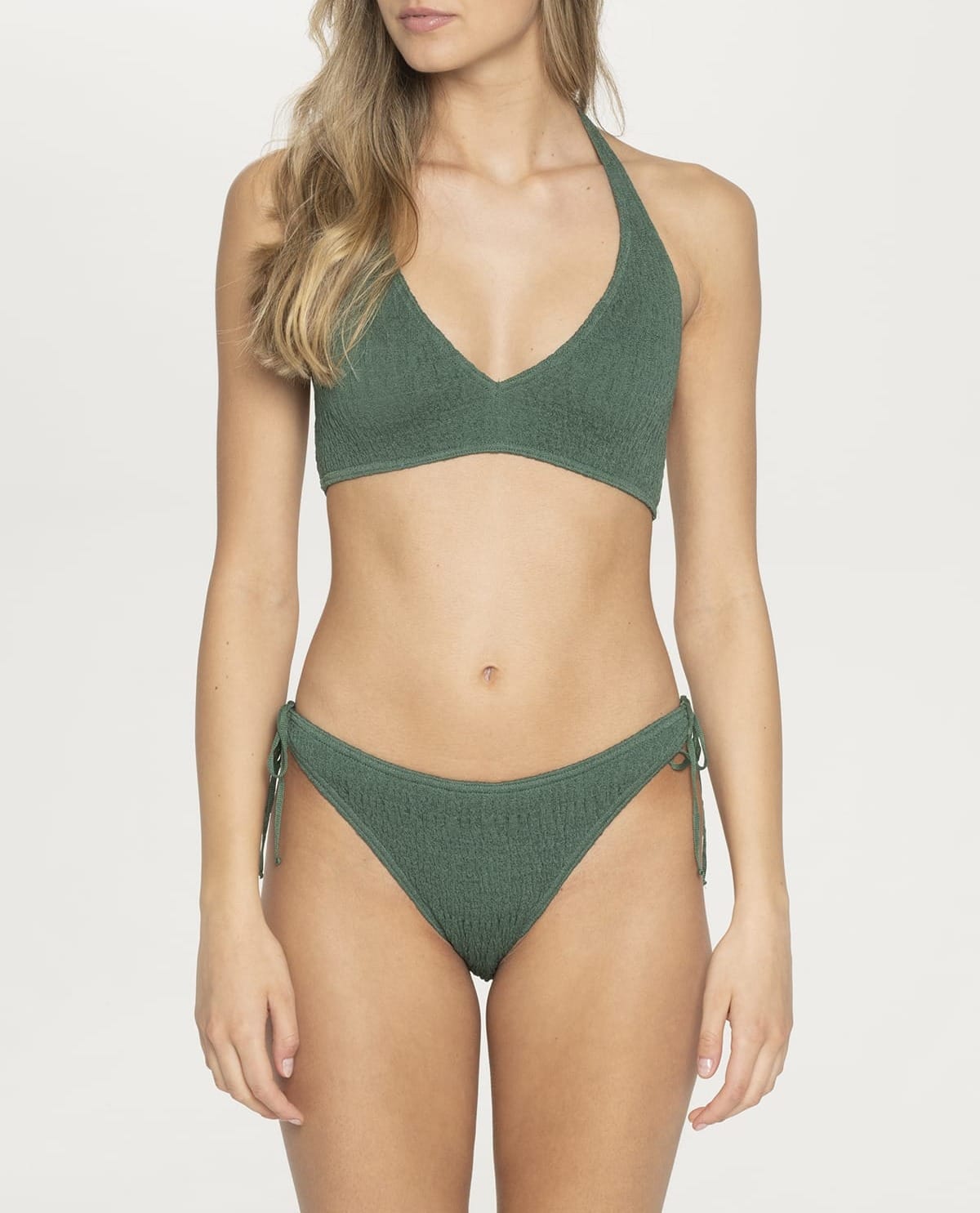
Choosing swimwear is often about style and fit. Yet one of the most important factors is rarely discussed: the fabric itself.
Most swimwear today is made from synthetic materials such as polyester, nylon, and elastane. However, increasing awareness around skin health and textile science has raised a more fundamental question:
What actually feels better — and is better — for your skin: cotton or synthetic swimwear?
This guide explores the real differences between natural and synthetic swimwear fabrics, focusing on skin interaction, breathability, and long-wear comfort.
Quick Answer: Cotton vs Synthetic Swimwear
- Synthetic swimwear → engineered for elasticity, durability, and water resistance
- Cotton swimwear → naturally breathable, softer, and more compatible with skin
The key difference is not just performance in water —
but how the fabric behaves on your skin over time.
Synthetic Swimwear: Engineered Fiber based Performance, Limited Breathability
Synthetic swimwear fabrics such as polyester and nylon are petroleum-derived polymers designed for performance.
They offer:
- high elasticity (with elastane)
- resistance to chlorine and saltwater
- fast surface drying
- structural stability
However, these fibres are hydrophobic, meaning they do not absorb moisture.
Instead, they:
- repel water
- trap humidity between fabric and skin
- rely on surface evaporation
This creates a more closed and less breathable microclimate, especially noticeable:
- under the sun
- after swimming
- during long wear
👉 For deeper insight, see: Is Synthetic Swimwear Bad for Skin?
Cotton Swimwear: Natural Interaction with Skin
Cotton is a natural cellulose fiber that behaves fundamentally differently from synthetic materials.ά.
It is hydrophilic, meaning it:
- absorbs moisture
- distributes it across the fiber structure
- allows gradual evaporation
This creates a more balanced and breathable environment on the skin.
Key characteristics:
- soft, natural surface
- improved airflow
- reduced heat accumulation
This is why cotton has been consistently used in garments worn directly on the skin for centuries.
The Core Difference: Skin Microclimate
The real comparison is not “performance vs performance” —
but microclimate on the skin.
Synthetic Fabrics
- trap heat and humidity
- reduce airflow
- create a more occlusive layer
Cotton
- allows air circulation
- regulates moisture naturally
- supports natural thermoregulation
Over time, this difference directly affects comfort, skin response, and overall wear experience — especially in environments where heat and humidity are elevated, such as beaches, spas, and sauna settings.
Long Wear: Where the Difference Becomes Clear
Swimwear is rarely worn only during swimming. It is often worn:
- for hours at the beach
- while drying
- in humid and warm conditions
- in saunas, spas, and thermal environments
In these scenarios:
- synthetic fabrics tend to feel warmer and less ventilated
- cotton maintains a more natural and breathable feel
This becomes particularly important for:
- sensitive skin
- heat sensitivity
- prolonged wear situations
- wellness environments where the body is exposed to heat and humidity
Addressing a Common Misconception About Cotton
Traditional cotton fabrics were not considered suitable for swimwear because they:
- absorbed large amounts of water
- lost shape when wet
- dried slowly
However, this applies to conventional cotton fabrics — not to engineered cotton textiles.
Modern textile innovation has introduced:
- high-twist yarns
- structured 3D knit constructions
- controlled internal elasticity
These developments allow cotton to achieve:
- shape stability in water
- faster drying through airflow
- improved durability
while maintaining 100% cotton contact with the skin.
Cotton vs Synthetic Swimwear – Side-by-Side
| Feature | Cotton Swimwear | Synthetic Swimwear |
| Fiber origin | Natural plant fibre | Petroleum-derived |
| Skin contact | Natural plant fibre | Synthetic filament |
| Breathability | High | Lower |
| Moisture behavior | Absorbs & regulates | Repels & traps |
| Heat retention | Lower | Higher |
| Skin compatibility | High | Low |
Which Fabric Is Better for Skin?
Cotton is better for the skin.
Not in theory — but in how it actually behaves in contact with the body.
Because cotton:
- allows the skin to breathe
- regulates moisture naturally
- avoids prolonged heat and humidity buildup
it provides a more stable and comfortable environment for the skin, especially during extended wear.
Synthetic fabrics may perform well mechanically,
but they do not offer the same level of skin compatibility.
Frequently Asked Questions
Is cotton better than synthetic fabrics for skin?
Yes. Cotton is more breathable and naturally compatible with skin, making it more comfortable for long wear.
Why is most swimwear synthetic?
Because synthetic fibers offer elasticity, durability, and water resistance, making them easier to mass-produce.
Do synthetic fabrics trap heat?
Yes. Synthetic fibers can create a warmer microclimate due to limited breathability.
Can cotton be used in swimwear?
Yes. With modern textile engineering, cotton can perform in water while maintaining its natural skin benefits.
Is cotton swimwear better for sauna or spa use?
Yes. In high-heat environments such as saunas and spas, breathable natural fabrics like cotton help regulate heat and moisture on the skin more effectively than synthetic materials.
Scientific Note
Synthetic textiles may contain substances associated with polymer production and textile finishing, including plasticizers, dyes, and treatment residues. Some studies have examined compounds such as phthalates, bisphenols, and PFAS in textile environments.
Exposure depends on fabric composition, processing, duration of wear, and environmental conditions. Research in this field is ongoing.
Research References
- International Journal of Dermatology
https://onlinelibrary.wiley.com/journal/13654632 - European Environment Agency
https://www.eea.europa.eu/en/analysis/publications/microplastics-from-textiles-towards-a-circular-economy-for-textiles-in-europe - OEKO-TEX® Standard 100
https://www.oeko-tex.com/en/our-standards/oeko-tex-standard-100 - Textile microfibers release study
https://www.nature.com/articles/s41598-019-43023-x
About the Author
This article is reviewed by the Pepper Vally® Textile Engineering Team in Athens, Greece.
Pepper Vally® develops patented cotton swimwear fabrics in-house (PCT/GR2025/000001), with a focus on fabric–skin interaction, breathability, and natural fiber performance in water.